Capability Domains for the Modern Enterprise
In my previous article, I explored the growing number of executive technology titles appearing across organisations.
Chief Data Officers.
Chief Analytics Officers.
Chief AI Officers.
Chief Digital Officers.
Chief Information Security Officers
Chief Information & Governance Officers
The proliferation of titles is often treated as a leadership trend. I think it reflects something much deeper. Modern enterprises are operating in fundamentally different environments than those for which many organisational structures were originally designed. This raises an important question:
What capability domains are modern organisations actually trying to govern?
The Enterprise Has Changed
For decades organisations operated around relatively stable structures.
Technology sat within IT
Data often sat within business functions
Governance sat within risk and compliance
Analytics emerged wherever capability happened to exist
Then the enterprise changed.
We moved from integrated systems to ecosystems of specialised platforms.
We moved from departmental data to enterprise data flows.
We moved from reporting to advanced analytics and artificial intelligence.
Yet many organisational structures continue to reflect assumptions from an earlier era. The result is often increasing overlap between executive roles and growing confusion around accountability. The challenge is no longer simply technology it is capability complexity.
Capability Before Title
Before creating new executive positions, organisations may need to answer a more fundamental question: What capabilities are actually emerging within the modern enterprise? Because if the capability is unclear:
Accountability inevitably becomes unclear.
Ownership becomes unclear.
Governance becomes unclear.
Decision-making becomes unclear.
I increasingly see four capability domains emerging across modern enterprises:
Technology Infrastructure
The platforms, integration, architecture, cybersecurity and operational environments that enable organisational capability.
Data Management
The management of data as an enterprise asset through architecture, metadata, quality, stewardship and lifecycle practices.
Analytics & Intelligence
The transformation of data into insight through reporting, analytics, modelling and artificial intelligence.
Governance & Accountability
The frameworks, decision rights, policies and oversight mechanisms that ensure organisational trust, accountability and sustainability.
These domains are distinct, but they are also highly interdependent.
Technology enables capability
Data connects the enterprise.
Analytics transforms information into insight.
Governance ensures those capabilities remain trusted.
Why More Chiefs Don't Always Create More Clarity
Many organisations have responded to increasing complexity by creating additional executive roles.
Yet in many cases:
governance structures remain unchanged
decision rights remain unclear
committees remain unchanged
accountability overlaps persist
The title changes, but the operating model does not. The result can be more complexity rather than more clarity.
Recently I met with a Chief Data and Analytics Officer whose role sat within a technology function while a newly appointed AI Officer sat elsewhere within the organisation. Neither structure was necessarily wrong. What interested me was the question it raised.: Which capability domains were these roles actually accountable for? This question is becoming increasingly important because organisations are often debating titles before they have defined the capabilities those titles are intended to govern.
Language Matters
One of the most overlooked aspects of organisational evolution is language. When organisational models change, language must evolve as well, otherwise people continue thinking in the old paradigm.
The term ERP reflected a particular organisational model.
The term Chief Information Officer reflected a particular technology environment.
Today organisations operate ecosystems of platforms, data flows, analytics capabilities and governance structures.
The capabilities have evolved but the language has often remained the same. This is not simply a semantic issue. Language influences how organisations think about accountability, capability and ownership. Perhaps this is why so many organisations are struggling with where data, analytics and artificial intelligence should sit. The organisational model has evolved. The language often has not.
One Possible Capability-Domain Model
The purpose of the following model is not to prescribe organisational design.
Every organisation will inevitably structure these responsibilities differently. Rather, it is intended to demonstrate how capability domains might be organised if leadership structures were designed around modern enterprise ecosystems rather than historical organisational models.
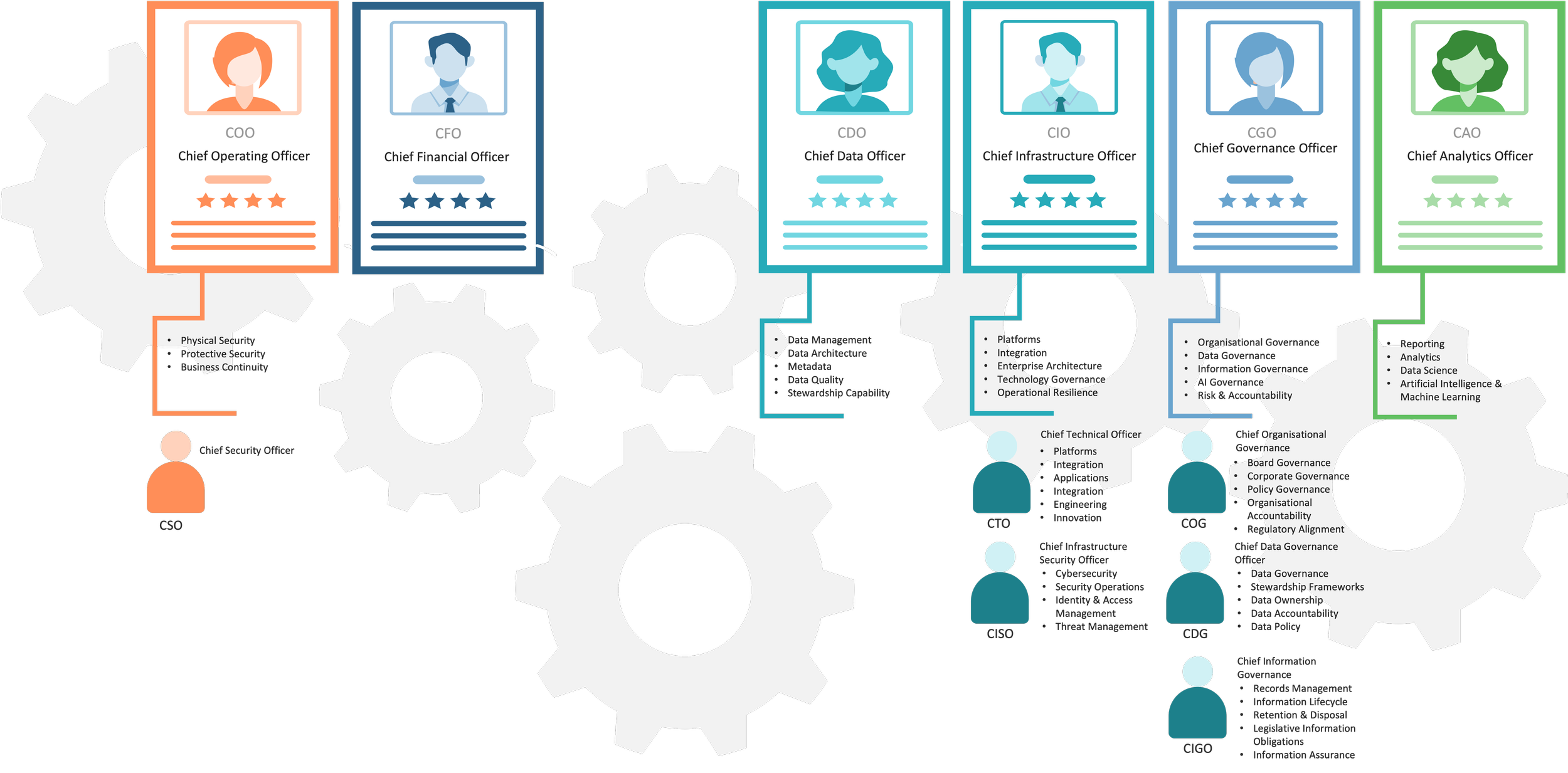
This support governance as decision infrastructure
The model is intentionally centred on capability rather than title. It recognises that organisations
Need technology infrastructure.
Need data management capability.
Need analytics and intelligence capability.
Need governance and accountability.
The reporting lines may vary but the capability domains remain.
The Important Distinction
One aspect of the model is particularly important, Artificial Intelligence appears within the Analytics & Intelligence domain.
Not because AI lacks importance but because AI is increasingly an extension of analytical capability rather than a completely separate enterprise domain.
Reporting.
Analytics.
Data Science.
Machine Learning.
Artificial Intelligence.
These capabilities exist along the same continuum. Creating a separate executive domain for every emerging technology may solve short-term accountability concerns, but it does not necessarily simplify the operating model. Similarly, governance remains distinct from management.
Governance establishes authority, accountability and trust whereas management delivers operational capability, between them sits stewardship. The bridge that translates governance decisions into operational practice. Without stewardship, governance often remains theoretical and without governance, operational capability often lacks direction.
Together they enable sustainable organisational capability.
Looking Forward
The challenge facing modern organisations is not deciding how many Chiefs they need. The challenge is ensuring that capability, accountability and governance evolve alongside the enterprise itself.
As organisations continue moving from integrated systems to platform ecosystems, capability complexity will continue to increase. The question is not whether new roles will emerge. The question is whether operating models evolve quickly enough to support them.
Technology enables capability.
Data connects the enterprise.
Governance ensures those connections remain trusted.
Leadership determines whether those capabilities create value.
Titles should follow capability. Not the other way around.
Platforms change.
Governed data endures.
— Fernleaf Advisory