From ERP to Platform Ecosystems: How the Enterprise Has Quietly Changed
For more than thirty years enterprise architecture focused on integrating organisations through systems. Enterprise Resource Planning (ERP) platforms promised something powerful:
• One integrated system
• One database
• One version of organisational truth
Systems such as SAP S/4HANA and their predecessors were designed to bring organisational processes together inside a single technology environment. For many organisations, ERP delivered exactly that, processes became more standardised, reporting improved and operational coordination increased. But look closely at how organisations actually operate today.
Human resources may run on Workday.
Customer relationships may run on Salesforce.
Finance systems, procurement platforms, analytics environments and artificial intelligence tools often sit alongside them.
These platforms do not consolidate into one system, they coexist, and this represents a quiet but significant shift in how enterprises function.
The Enterprise No Longer Runs on One System
The ERP era assumed that integrating the organisation meant integrating systems, but most modern organisations now operate ecosystems of specialised digital platforms, each responsible for a different organisational capability.
Human resources may run on Workday.
Customer relationships may run on Salesforce.
Finance platforms manage transactions and reporting.
Analytics environments process data for forecasting and decision support.
Artificial intelligence platforms increasingly support advanced modelling and automation.
These platforms do not consolidate into one system, they coexist, and they continuously exchange data across the enterprise.
This represents a significant shift in how organisations operate. The enterprise is no longer contained inside a single integrated system, it exists across a network of specialised platforms connected through data. Digital platforms today are designed for specialised capability rather than universal integration. Each platform performs a specific role within the organisation, forming the operational infrastructure of the modern enterprise. But infrastructure alone does not create reliable information, as organisations move from single systems to platform ecosystems, something else becomes central: the integrity of the data flowing between systems.
Which means the core architectural challenge facing organisations has changed.
The question is no longer: How do we integrate systems?
The question has become: How do we ensure the data flowing between systems remains trusted?
The Data Spine of the Enterprise
Every digital platform produces data, every operational process generates data and every analytical model consumes data.
This continuous movement of information across systems forms what can be described as the data spine of the enterprise.
Data flows from operational systems into analytics environments, it moves between HR platforms and payroll systems, it feeds forecasting models and AI systems.
In many organisations, even artificial intelligence models are ultimately derived from this flow of enterprise data.
The platforms may differ, the tools may evolve, but the data spine connects them all.
The shift from integrated ERP systems to ecosystems of specialised platforms fundamentally changes how organisations must think about enterprise architecture. The enterprise is no longer stabilised by a single system it is stabilised through the interaction between digital platforms, data flows and governed accountability structures.
The Fernleaf Governed Data Ecosystem™ below illustrates this shift.
The Fernleaf Governed Data Ecosystem™
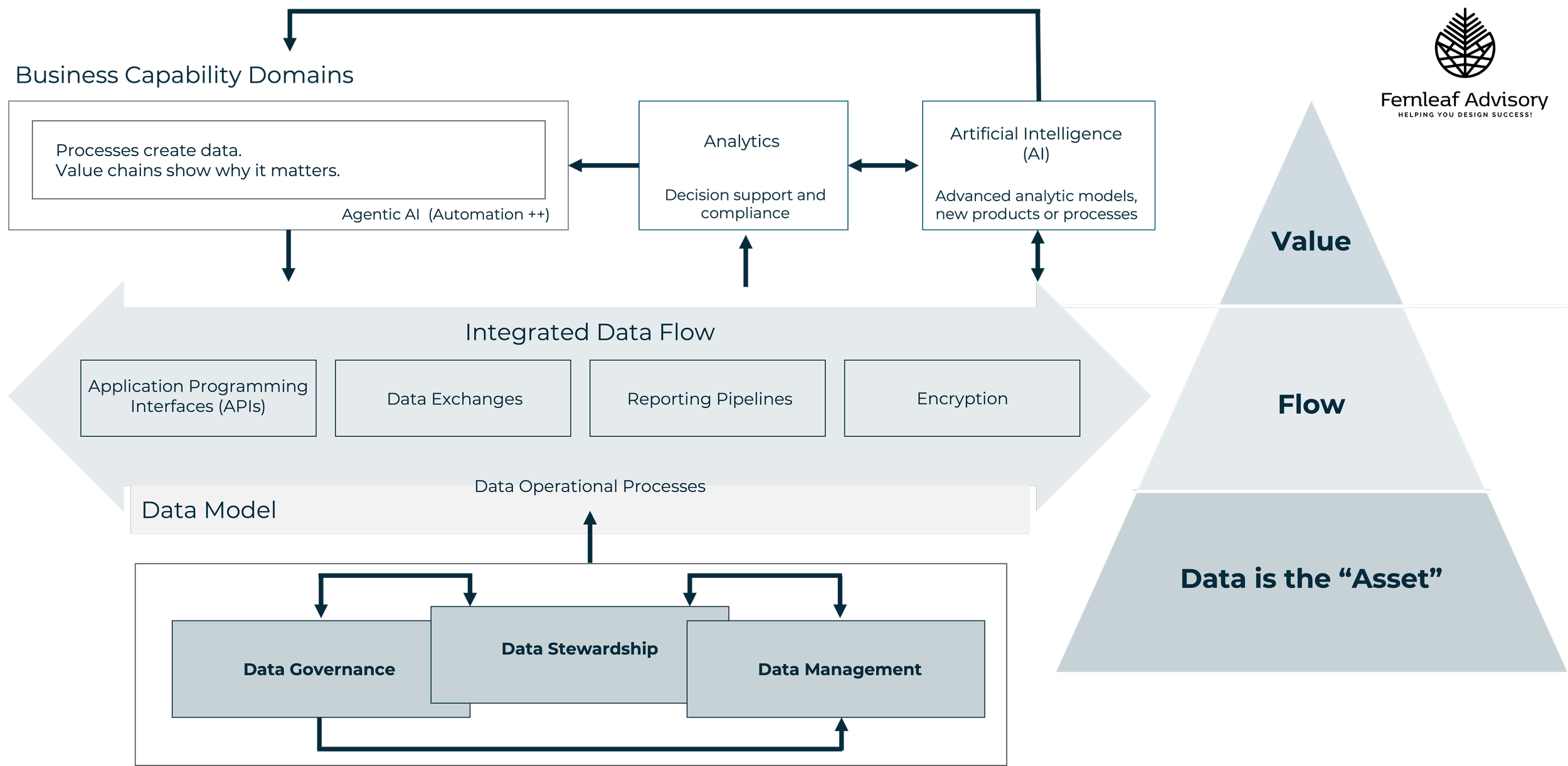
Digital platforms enable capability, data flows connect the enterprise, and governance ensures those flows remain trusted.
Governance Becomes the Stabilising Force
When organisations operated primarily within ERP systems, governance was often embedded within the system itself. Process rules, data structures and workflows were defined inside the platform. But in platform ecosystems no single system controls the environment.
Instead organisations must coordinate:
Data definitions
Ownership and accountability
Policy and standards
Stewardship practices
This coordination is the role of data governance. Governance ensures that the data flowing across platforms remains consistent, understood and trustworthy, without governance, the data spine of the enterprise begins to fragment.
Definitions diverge.
Ownership becomes unclear.
Decisions become harder to trust.
When Organisational Models Change, Language Must Evolve
This shift from integrated systems to platform ecosystems has another consequence. The language organisations use to describe technology leadership is beginning to change.
For decades the term Chief Information Officer (CIO) reflected an era when enterprise technology primarily managed information systems.
But modern organisations operate digital infrastructure that includes cloud environments, platform ecosystems, integration architectures and data platforms. In practice, the role increasingly resembles Chief infrastructure leadership for digital capability, rather than simply managing “information technology”.
As organisational models evolve, the language used to describe them often evolves as well. If the language does not change, organisations can find themselves thinking in the old paradigm even as their operating model has already moved on.
Technology, Data and Governance
Modern enterprises now operate through three interacting forces.
Digital platforms enable organisational capability.
Data flows connect systems and processes across the enterprise.
Governance ensures those flows remain trusted.
Leadership behaviour determines whether organisations use those capabilities effectively. Modern organisations are not stabilised by systems, they are stabilised by governed data flowing across platforms.
A New Enterprise Capability Landscape
As enterprises adopt platform ecosystems, leadership structures are evolving as well.
Technology infrastructure, data management, analytics capability and governance authority are increasingly recognised as distinct capability domains. These capabilities work together to stabilise the modern enterprise.
In the next article, I explore why technology leadership is fragmenting across roles such as CIO, CDO and emerging analytics and governance leadership roles and what this means for organisations navigating the shift to governed data ecosystems. Including the emergence of new executive capability domains across technology, data, analytics and governance.
“Platforms change.
Governed data endures.”